

Progress and setbacks for Canadian salmon farming in 2025
Sustainability report shows mixed picture for sector
Canada’s salmon farming sector reduced fish escapes, antibiotic use, and the proportion of certified marine ingredients in feed last year when compared to 2024, new figures show.
But a key metric – fish survival – dipped from 90.2% in 2024 to 85%, which was more in line with previous years.
The statistics are included in the 2026 Sustainability Report from Canadian Seafood Farmers (formerly the Canadian Aquaculture Industry Alliance), which covers all seven salmon farming companies operating during 2024 and 2025.
The participating companies were Atlantic salmon farmers Cermaq Canada, Cooke Aquaculture Inc., Mowi Canada East, Mowi Canada West, Grieg Seafood British Columbia, and Grieg Seafood Newfoundland, along with BC chinook farmer Creative Salmon. Grieg has since sold its Canadian operations to Cermaq, and Mowi has agreed to sell Canada East to Cooke.
Environmental conditions
“Sector-wide survival was over 90% in 2024 and 85% in 2025. The decline reflects algae blooms, low oxygen events, and challenging environmental conditions,” writes Canadian Seafood Farmers (CSF) in the report. Previous survival rates were 81.9% in 2022 and 84.9% in 2023.
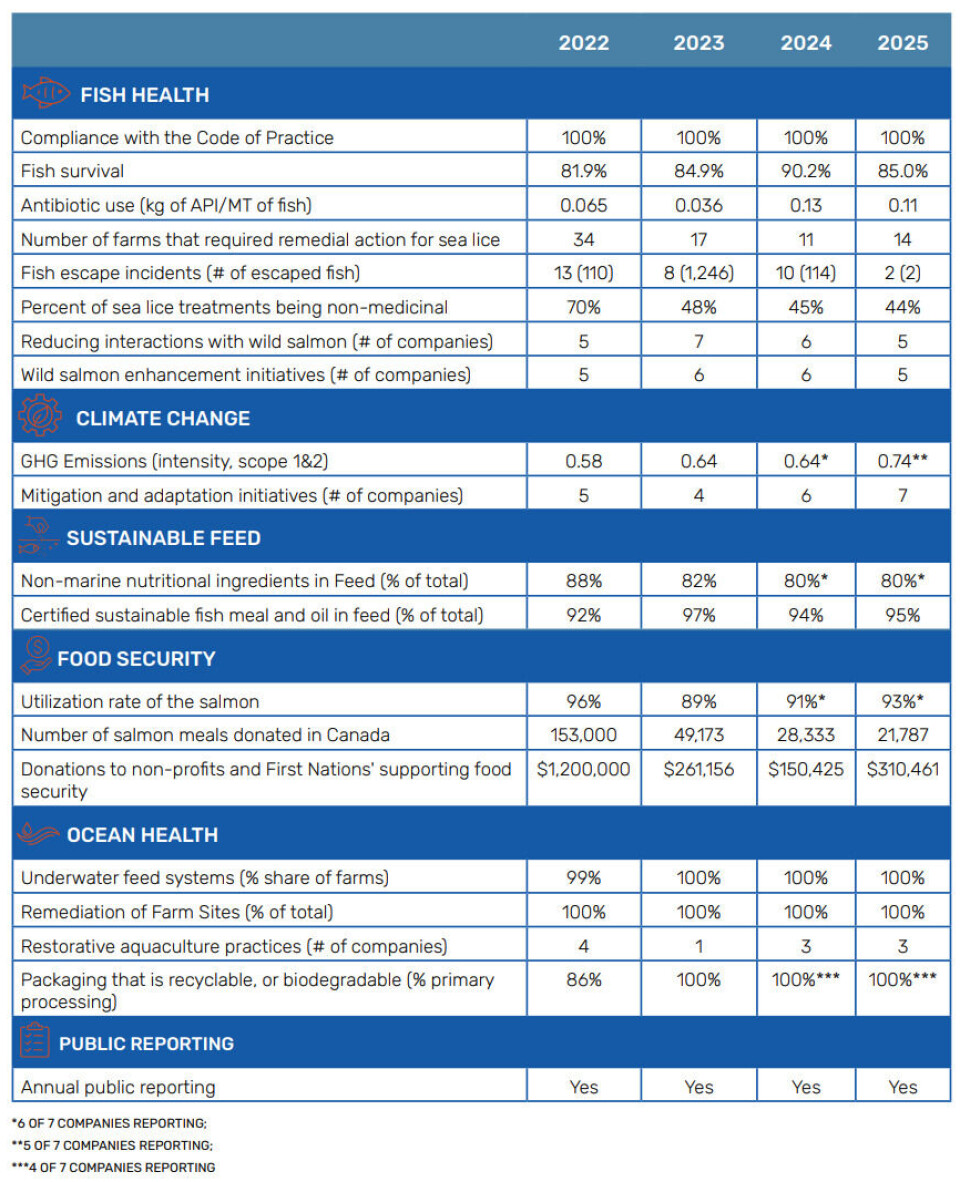
Antiobiotic use fell from 0.13 kg per tonne of fish produced in 2024 to 0.11 kg/t, although this figure remains higher than in 2022 (0.065 kg/t) and 2023 (0.036 kg/t).
“A variety of reasons led to an increase in this metric in 2024 and 2025. In some parts of the country, warmer water temperatures and elevated salinity associated with dry conditions impacted the growout phase in the marine environment; elsewhere, treatment of the fish at a larger size required higher dosage,” writes CSF.
“All antibiotics used in Canadian salmon farming are strictly regulated, prescribed and overseen by licensed veterinarians, and fish cannot be harvested until mandatory withdrawal periods have passed to ensure no harmful antibiotic residues remain in the edible flesh.”
CSF also points out that fish farmers in Canada have very restricted access to medicines and treatments that are common in competitor nations, and that better access to a diversity of treatment options would help minimise the need for antibiotics.
Sea lice
The percentage of non-medicinal sea lice treatments was 44%, the lowest since the sustainability reports began in 2022, when 70% of treatments were mechanical. That fell to 48% in 20223 and 45% in 2024.
“Veterinarians and farmers rely on a variety of treatments to protect efficacy and maximise animal health and welfare, while working with the specialised equipment, vessels, and registered products available,” writes CSF.
There were just two escape incidents recoded in 2025, each involving one fish and both attributable to human error.
“Achieving zero escapes annually is the sector’s goal. Continuous improvements in technology and new safeguards have helped reduce escapes over the past decade,” says CFS in the report.
GHG emissions
Greenhouse gas emissions per kilogram of salmon production increased slightly to 0.74 in 2025, up from 0.58 in 2022 and 0.64 in 2023 and 2024. The increase reflects the higher energy requirements of semi-closed and closed containment systems and marine sites in more remote areas without access to land-based power.
“The sector continues to pursue renewable energy, electrified equipment, and shore-based power solutions to reduce emissions over time,” says CSF.
Feed
The percentage of non-marine nutritional ingredients in feed was 80% in both 2024 and 2025, down from 82% in 2023 and 88% the year before that. The proportion of certified sustainable fish oil and fishmeal used in feed increased to 95% last year, up from 94% in 2024 but below the 97% achieved in 2023.
“Almost all the fish meal and oil used in salmon feed is from certified sustainably managed/FAO compliant fisheries. These certifications, including standards such as MarinTrust and the Marine Stewardship Council (MSC), provide independent verification that marine ingredients are sourced from responsibly managed fisheries,” says CSF.
“Requirements address legal harvesting, sustainable stock management, ecosystem impacts, traceability and alignment with internationally recognised fisheries management principles, including the FAO Code of Conduct for Responsible Fisheries. The remaining gap is a supply-chain (i.e. availability) and certification challenge rather than an intentional use of unsustainable sources. The sector is committed to reaching 100%.”
Non-marine feed ingredients include grains and other plant-based and alternative ingredients.
“New innovations in feed – for example in omega-3 rich algae oils, single-cell protein fermentation, and insect proteins – are being developed and tested. In 2024, over $250 million in grains, seeds, oils and other proteins from Canada’s farmers was used in feed on Canadian salmon farms,” says the report.


