

Taking fish out of feed 'may do more harm than good'
In the wake of controversial documentaries such as Seaspiracy and Ocean, scientists warn that replacing caught fish with terrestrial ingredients would require a huge amount of land, and could in fact increase damage to biodiversity
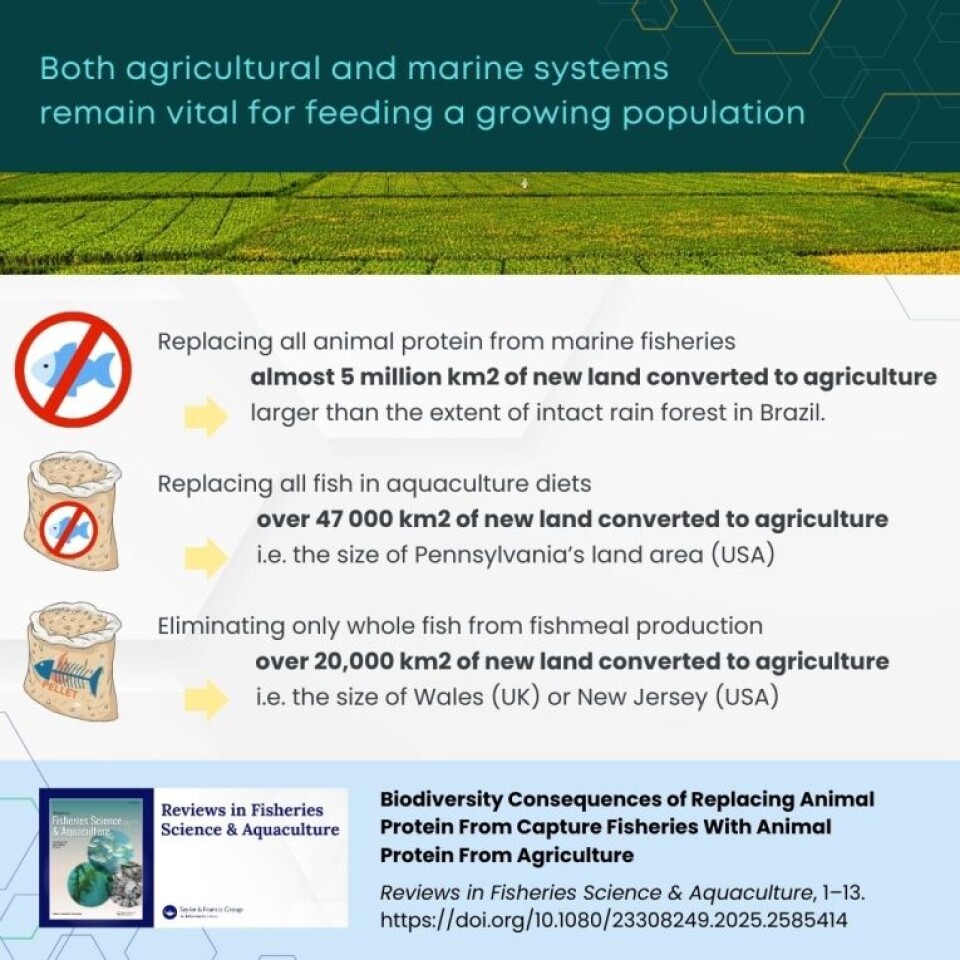
Replacing all fish in aquafeed with plant-based ingredients would result in the need for more an area twice the size of Wales or the US state of New Hampshire to be converted to agricultural production, resulting in biodiversity loss, an academic paper has warned.
The study, lead authored by Australian sustainable fisheries expert Duncan Leadbitter, is the outcome of a workshop funded by marine ingredients organisation IFFO that brought together leading scientists to explore the impacts of global food production.
The peer-reviewed paper’s key conclusion is that replacing animal protein sourced from marine capture fisheries with animal protein from agriculture will likely increase the threats to biodiversity.
Land use change
They point out that an expanding global population is already driving an increasing demand for food production, further accelerating land use change, which is widely accepted as being the major factor driving global biodiversity loss.
While there is a wide range of farming methods, and not all crops have equal impacts, there is limited potential to produce food on land without removing native vegetation, the authors write.
“Consumers, especially in the global North, live in a sea of claims about the sustainability of various foods. The documentary Seaspiracy claimed that sustainable fishing is not possible and the more recent documentary Oceans will have raised questions about seafood consumption in the minds of millions of people,” the authors say the introduction to the open-access paper, published in Fisheries Science & Aquaculture journal.
They add that environmental considerations are now influencing official dietary advice in some countries, and that although reducing the consumption of meat and fish will have environmental benefits from an energy perspective, it is unlikely to occur.
A wrong assumption?
“The underlying assumption is that the comparative impacts of agriculture versus fisheries favour agriculture, but this may not be the case, especially when biodiversity is the basis for the comparison,” write the scientists.
“This paper evaluates some potential consequences of major changes to fishery resources access resulting from concerns about the impacts of fishing. The central theme is an examination of whether the replacement of marine-sourced animal proteins environment by land-sourced proteins would be beneficial for global biodiversity.”
In the paper’s abstract, the authors say that replacing all animal protein from marine fisheries could require almost an additional 5 million square kilometres of land – larger than the extent of intact rain forest in Brazil – if replaced by the current proportional combination of livestock and poultry. Replacing all fish in aquaculture diets would result in the need for over 47,000 square kilometres - twice the area of Wales or New Hampshire - of new land converted to agricultural production.
Bigger threat from agriculture
“Concomitantly, data show that terrestrial and freshwater species are more likely to be threatened with extinction than marine species and that agriculture is the dominant cause of these extinctions,” the authors write.
“This paper suggests that extinction risks per million tonnes of animal protein produced are 2.6 times higher for agriculture than marine capture fisheries. Agriculture is the main driver of extinctions because it is predicated on the conversion of complex, natural ecosystem structures to simple, human-dominated systems, whereas well-managed fisheries seek to work within natural ecosystem structure and function.
“Available evidence suggests that relying even more on land-based animal foods by replacing marine with terrestrial protein sources may cause more biodiversity loss, not less. Policy makers need to consider the implications of restricting the use of fishery resources on planetary biodiversity beyond measures aimed at attaining sustainable use.”

Localised comparisons
IFFO technical director Brett Glencross said: “This peer-reviewed article underscores the essential role of responsibly managed fisheries in sustainable food systems and biodiversity protection.
“Despite their impacts, agricultural systems remain vital for feeding a growing population. However, more tools are needed to enable objective, localised comparisons between the biodiversity impacts of land-based animal protein production and marine fishing. With this in mind, IFFO has started a pilot project to transition current discussions to a biodiversity framework outlining indicators to measure impacts and guide decision-making.”
Leadbitter, a former director of the Marine Stewardship Council (MSC) and former Visiting Fellow at the Australian Centre for Ocean Resources and Security (ANCORS) at Wollongong University, said: “There are choices to be made as to how more food will be produced in the coming decades and what unintended land use and biodiversity consequences will be produced from these decisions.
“Well-managed fisheries do not rely on fundamental changes to ecosystems in the way that agriculture does and there is lots of progress in improving fisheries management under way.”
The paper, Biodiversity Consequences of Replacing Animal Protein From Capture Fisheries With Animal Protein From Agriculture, is published in Reviews in Fisheries Science & Aquaculture.


